2026-06-05
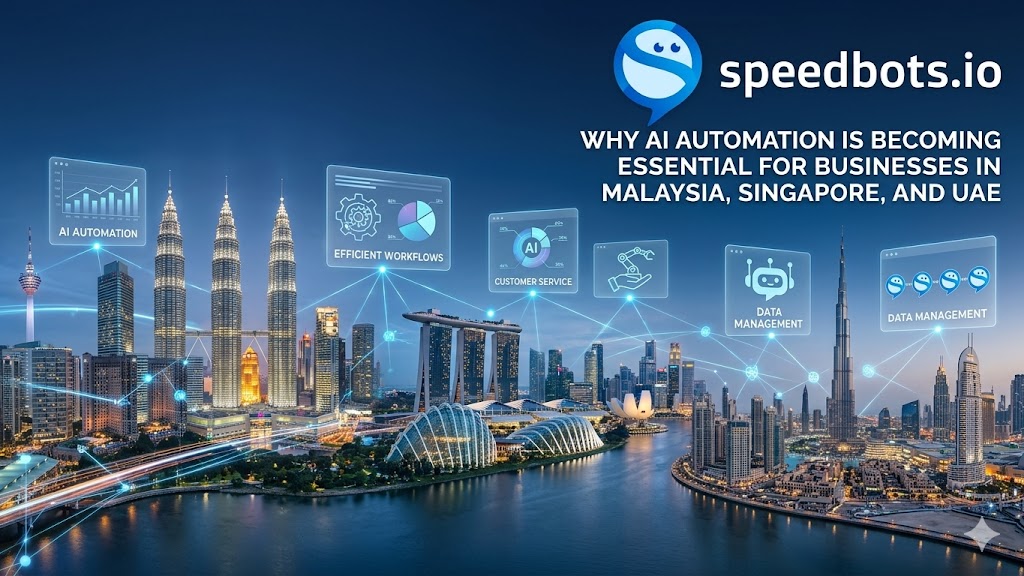
Why AI Automation Is Becoming Essential for Businesses in Malaysia, Singapore, and UAE.
Why AI Automation Is Becoming Essential for Businesses in Malaysia, Singapore, and UAE.
Businesses across Malaysia, Singapore, and the UAE are experiencing rapid digital transformation. As customer expectations evolve and competition intensifies, organizations are under increasing pressure to improve efficiency, reduce operational costs, and deliver exceptional customer experiences. In this environment, AI automation has emerged as a powerful solution that helps businesses streamline operations, make smarter decisions, and scale sustainably.
From customer support and sales processes to internal workflows and data management, AI automation is changing the way companies operate. Businesses that embrace automation are finding new opportunities for growth, while those that delay adoption risk falling behind in an increasingly technology-driven market. As a leading provider of intelligent automation solutions, SpeedBots helps businesses simplify complex processes, improve productivity, and accelerate digital transformation across various industries.
This article explores why AI automation is becoming essential for businesses in Malaysia, Singapore, and the UAE and how organizations can leverage it to gain a competitive advantage.
The Growing Demand for Business Automation
Modern businesses generate enormous amounts of data and handle numerous repetitive tasks daily. Manual processes often lead to inefficiencies, delays, and human errors that can impact productivity and customer satisfaction.
AI automation addresses these challenges by enabling businesses to automate repetitive tasks, process information quickly, and support decision-making with intelligent insights. As a result, employees can focus on higher-value activities such as innovation, customer relationships, and strategic planning.
Organizations across industries are recognizing that automation is no longer just an option it is becoming a necessity for maintaining operational efficiency and competitiveness. With innovative solutions from SpeedBots, businesses can automate critical workflows, enhance operational efficiency, and create scalable systems that support long-term growth in today’s fast-paced digital economy.
Why Businesses in Malaysia Are Adopting AI Automation
Malaysia’s digital economy continues to grow rapidly, encouraging businesses to invest in modern technologies that improve productivity and customer engagement. As the demand for digital transformation increases, AI Automation in Malaysia is helping organizations streamline operations, enhance customer experiences, and achieve sustainable business growth.
Improved Operational Efficiency
Businesses in Malaysia are increasingly using AI automation to streamline workflows, reduce manual effort, and accelerate routine business processes. Automated systems can handle tasks around the clock, reducing delays and improving overall efficiency while enabling teams to focus on strategic initiatives.
Better Customer Service
Customers expect quick responses and seamless interactions. AI-powered automation helps businesses provide instant support, answer common inquiries, and improve customer satisfaction without increasing staffing costs. This allows organizations to maintain high service standards while managing growing customer demands.
Cost Reduction
Many Malaysian businesses are looking for ways to optimize resources and reduce operational expenses. Automation enables organizations to accomplish more with fewer manual processes, resulting in significant cost savings over time and improved operational performance.
Enhanced Decision-Making
AI automation can analyze large volumes of business data and provide valuable insights. This helps leaders make informed decisions based on real-time information rather than relying solely on assumptions. As adoption continues to grow, AI Automation in Malaysia is becoming a key driver of smarter business strategies and long-term competitiveness.
Why Singapore Is Leading the AI Automation Movement
Singapore has established itself as a global innovation hub with a strong focus on digital transformation and technological advancement. As businesses continue to embrace AI Automation in Singapore, organizations are discovering new ways to improve efficiency, reduce operational costs, and stay competitive in a rapidly evolving market.
High Demand for Productivity
As businesses face increasing labor costs and growing customer expectations, automation has become a practical solution for maintaining productivity and efficiency. AI Automation in Singapore helps companies streamline repetitive tasks, optimize workflows, and enable employees to focus on higher-value activities that drive business growth.
Faster Business Growth
AI automation allows companies to scale operations without proportionally increasing workforce requirements. This enables businesses to expand more efficiently while maintaining consistent service quality and operational consistency.
Improved Customer Experiences
Singaporean consumers expect personalized and responsive interactions. AI automation helps businesses deliver tailored experiences by analyzing customer behavior, anticipating customer needs, and providing relevant recommendations that improve engagement and satisfaction.
Competitive Advantage
Businesses in Singapore operate in highly competitive markets. Organizations that adopt AI automation can gain a significant advantage by responding faster to customer needs, improving operational efficiency, and making data-driven decisions that support long-term growth.
Why UAE Businesses Are Investing in AI Automation
The UAE is rapidly becoming one of the most technology-driven economies in the world. Businesses across sectors are embracing AI automation to support innovation and long-term growth. As organizations continue to invest in digital transformation, AI Automation in UAE is helping businesses improve efficiency, enhance customer experiences, and gain a competitive edge in both regional and global markets.
Accelerating Digital Transformation
Companies in the UAE are actively modernizing their operations to stay competitive in a global market. AI automation plays a critical role in this transformation by improving efficiency, reducing manual processes, and enabling smarter workflows across departments.
Meeting Rising Customer Expectations
Customers increasingly expect immediate responses and personalized experiences. AI automation helps businesses deliver these expectations while maintaining operational efficiency, ensuring consistent service quality and stronger customer engagement.
Supporting Business Expansion
Many UAE-based businesses serve regional and international markets. Automation allows organizations to manage larger customer volumes and business processes without sacrificing quality, making it easier to scale operations and support growth objectives.
Data-Driven Business Strategies
Organizations are leveraging automation to analyze business data, identify trends, and uncover opportunities for growth. This helps leaders make strategic decisions with greater confidence and respond quickly to changing market conditions. As adoption continues to increase, AI Automation in UAE is becoming an essential component of modern business success and long-term sustainability.
Key Benefits of AI Automation Across All Three Markets
While each market has unique characteristics, businesses in Malaysia, Singapore, and the UAE are experiencing similar benefits from AI automation. Companies working with automation specialists such as SpeedBots are leveraging intelligent solutions to improve efficiency, streamline workflows, and accelerate growth.
Increased Productivity
Automation eliminates repetitive tasks and reduces manual workloads. Employees can focus on strategic initiatives that contribute directly to business growth and innovation.
Improved Accuracy
Manual processes often result in errors that can impact operations and customer experiences. Automated systems perform tasks consistently and accurately, reducing costly mistakes and improving reliability.
Enhanced Customer Engagement
AI automation enables businesses to respond quickly to customer inquiries, provide personalized experiences, and maintain high service standards across multiple channels.
Scalability
As businesses grow, operational complexity increases. Automation allows organizations to scale processes efficiently without significantly increasing resources, making expansion more manageable.
Better Resource Utilization
Companies can allocate time, talent, and resources more effectively by automating routine activities and focusing on value-driven work.
Faster Response Times
Customers appreciate speed and convenience. Automated systems help businesses deliver faster responses, improving customer satisfaction and retention.
Common Areas Where Businesses Use AI Automation
Organizations across industries are implementing automation in various functions to improve performance and efficiency. Solutions developed by SpeedBots can help businesses automate critical processes while maintaining operational flexibility.
Customer Support
Businesses use AI automation to handle frequently asked questions, provide instant responses, and support customers around the clock.
Lead Management
Automation helps businesses capture, qualify, and manage leads more effectively, improving sales efficiency and conversion rates.
Marketing Operations
Companies automate campaign management, customer segmentation, and engagement workflows to improve marketing performance and customer targeting.
Data Processing
AI automation can process large volumes of information quickly, helping businesses extract valuable insights and improve decision-making.
Administrative Tasks
Routine tasks such as scheduling, reporting, document management, and workflow approvals can be automated to reduce administrative burdens.
Internal Communication
Automation improves collaboration by ensuring information is shared efficiently across departments and teams.
Challenges Businesses Can Overcome with AI Automation
Many organizations face challenges that hinder growth and efficiency. AI automation provides solutions to several common business problems.
Labor Shortages
Businesses often struggle to find and retain skilled talent. Automation helps fill operational gaps by handling repetitive tasks efficiently.
Rising Operational Costs
Increasing expenses can impact profitability. Automation reduces the need for manual intervention, helping businesses control costs and optimize resources.
Inconsistent Customer Service
Maintaining consistent service quality can be difficult as businesses grow. Automated systems ensure customers receive reliable and timely support.
Information Overload
Organizations generate vast amounts of data daily. AI automation helps process and analyze information, making it easier to identify actionable insights and business opportunities.
The Future of AI Automation in Malaysia, Singapore, and UAE
The adoption of AI automation is expected to accelerate significantly in the coming years. Businesses that invest early will be better positioned to capitalize on emerging opportunities and market trends.
As technologies continue to evolve, automation will become increasingly sophisticated, enabling organizations to deliver more personalized customer experiences, improve operational efficiency, and make smarter decisions. Industry leaders such as SpeedBots are helping businesses navigate this transformation by implementing scalable automation strategies tailored to modern business needs.
Companies that view AI automation as a strategic investment rather than a short-term solution will likely achieve stronger growth, higher productivity, and greater resilience in an ever-changing business landscape.
Conclusion
AI automation is no longer a futuristic concept-it is a business necessity. Organizations across Malaysia, Singapore, and the UAE are leveraging automation to improve efficiency, reduce costs, enhance customer experiences, and support long-term growth.
As competition intensifies and customer expectations continue to rise, businesses that embrace AI automation will be better equipped to adapt, innovate, and thrive in the digital economy. With the support of experienced automation partners like SpeedBots, companies can accelerate their digital transformation journey and unlock new opportunities for sustainable growth.
The question is no longer whether businesses should adopt AI automation, but how quickly they can implement it to stay ahead of the competition and unlock new opportunities for success.
FAQ Section
1. How long does it take to implement AI Automation in a business?
The implementation timeline depends on the complexity of business processes and automation requirements. Simple workflows can often be automated within a few weeks, while larger enterprise solutions may require several months for deployment and optimization.
2. Is AI Automation suitable for small and medium-sized businesses (SMEs)?
Yes. AI Automation helps SMEs improve productivity, reduce manual workloads, enhance customer service, and scale operations efficiently without significantly increasing operational costs.
3. What is the return on investment (ROI) of AI Automation?
Businesses typically see ROI through reduced operational expenses, increased productivity, faster response times, improved customer satisfaction, and better resource allocation. The exact return depends on the processes being automated.
4. Can AI Automation be integrated with existing business systems?
Modern AI Automation solutions can integrate with existing software, databases, communication tools, and operational platforms, allowing businesses to improve efficiency without disrupting current workflows.
5. Is AI Automation secure for handling business data?
Yes. AI Automation solutions are designed with security measures such as data encryption, access controls, monitoring systems, and compliance standards to help protect sensitive business information.
6. How does AI Automation help businesses scale faster?
AI Automation enables businesses to handle higher volumes of customer interactions, operational tasks, and data processing without requiring proportional increases in staffing, making growth more sustainable and cost-effective.
7. What should businesses consider before implementing AI Automation?
Businesses should identify repetitive processes, define clear automation goals, evaluate existing workflows, determine success metrics, and choose solutions that align with their long-term growth and operational objectives.